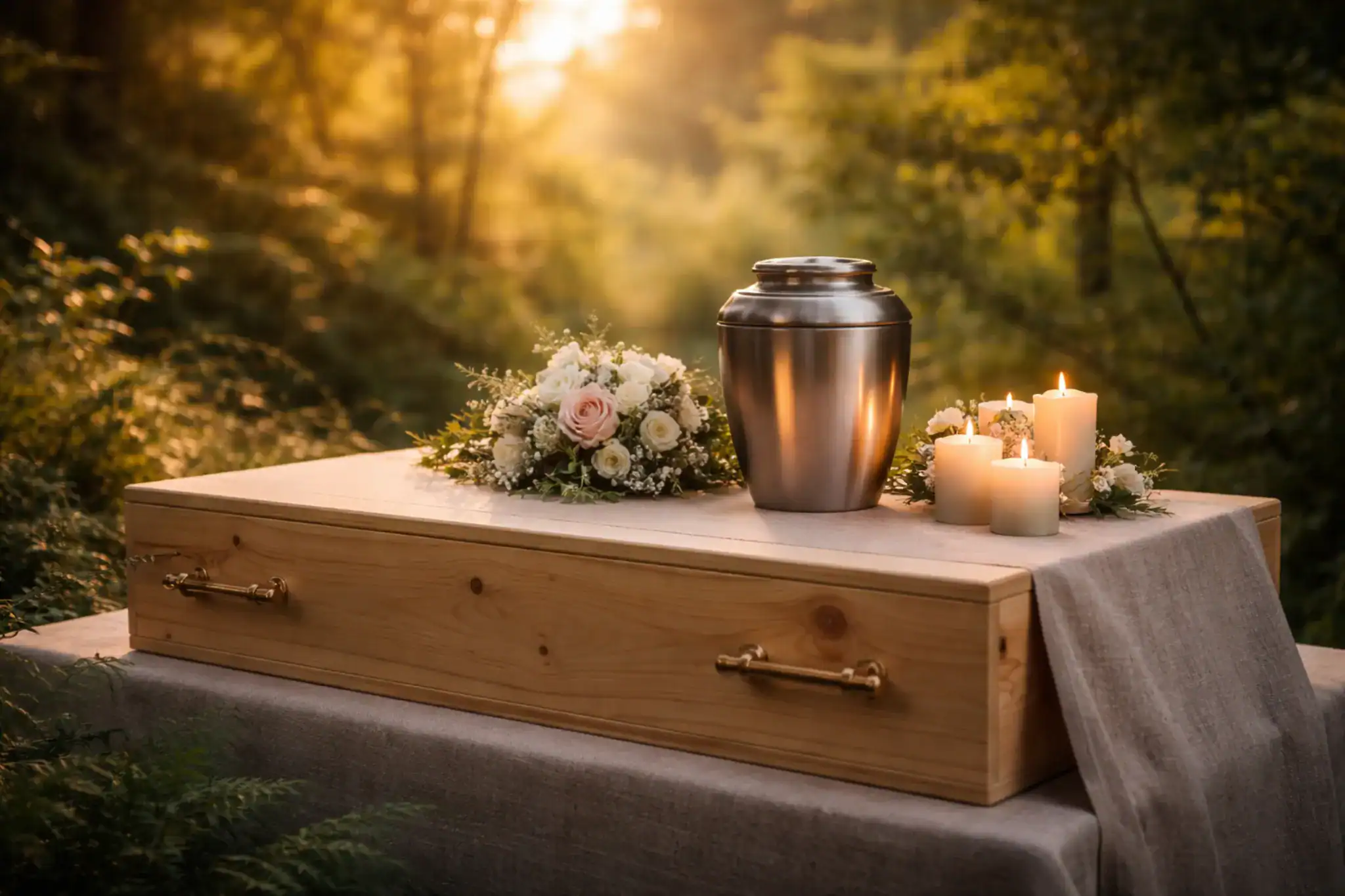

In an era where personalization trumps tradition and practicality often overrides pomp, the American way of saying goodbye is undergoing a profound transformation.
Gone are the days when a traditional funeral service—complete with caskets, eulogies, and crowded chapels—was the default response to loss.
Today, a growing number of families are opting for do-it-yourself memorials, intimate gatherings, or even skipping any form of tribute altogether.
According to recent data, the U.S. cremation rate reached nearly 62% in 2024, with projections indicating it will surpass 80% by 2035.

Direct Cremate reports that a striking 41% select “direct cremation”—a no-frills process with no service at all—while 35% follow up with a separate memorial, and only 24% include a full funeral home service.
However, accurate data on the actual division of cremation services is not readily available from the Cremation Association of North America [CANA] nor from other funeral industry associations.
It is not cremation per se that is radically disrupting the funeral industry, but rather the shift to avoid any funeral or memorial services provided by the industry. Many funeral homes are still hesitant to acknowledge that families no longer need to overspend to pay tribute today.
Direct cremation accounts for nearly 80% of cremation cases for most DFS Memorials providers, which focus on affordable and straightforward direct cremation offerings.
Providers in major metro areas, such as Houston and Miami, are offering complete direct cremation services for just $795.
This shift isn’t just a statistic; it’s a mirror reflecting more profound societal changes. But why are we abandoning these age-old rituals? And what does it mean for how we grieve, connect, and remember?
The Crushing Weight of Cremation Costs: Death’s Unexpected or Hidden Price Tag

Let’s start with the elephant in the room—or rather, the casket in the parlor. Funerals are expensive, and in a time of economic uncertainty, they’re increasingly seen as an avoidable luxury.
The average cost of a traditional burial is approximately $7,848, excluding cemetery fees, headstones, and flowers. Contrast that with direct cremation, which can cost less than $1,000, and it’s no wonder families are rethinking their options.
Inflation and rising living costs have only exacerbated this trend in recent years, with surveys indicating that 28% of Americans have altered their funeral plans due to financial distress, according to Choice Mutual.
If a family member passes away today with no life insurance or funeral plan, most families struggle to find the money to pay for a cremation service. And often discover that they have no alternative but to opt for the most affordable direct cremation option.
But is money the sole culprit, or a convenient scapegoat?

While cost is often cited as the primary driver—especially in online discussions where families lament the “overwhelming” expense—personal stories reveal a more complex reality.
One caregiver shared on a forum:
“I really do not want to do a service when my mom passes. My family was not supportive at all and feel it will bring up hard feelings.”
Here, skipping a funeral isn’t just about saving dollars; it’s about avoiding emotional debt. Yet, this raises a thorny question: In prioritizing affordability, are we commodifying grief, turning a sacred rite into a line item on a budget sheet? Or are we finally liberating ourselves from an industry that preys on vulnerability?
Evolving American Beliefs: From Sacred Rites to Secular Choices
Religion has long anchored funeral traditions in the U.S., with services rooted in Christian, Jewish, or other faith-based customs. But as affiliation wanes—fewer Americans identify as religious today than ever before—these rituals feel increasingly out of step.
Cremation’s rise, now at 61.9% and climbing, is partly fueled by this secular shift, allowing families to bypass church-led ceremonies in favor of something more neutral or absent entirely.

Research echoes this: People are rejecting formal funerals because they no longer align with personal beliefs or provide the assumed therapeutic value.
In one study, mourners who opted out reported feeling more in control of their grief, choosing invitation-only “celebrations of life” or nothing at all to avoid obligatory social niceties.
This interrogation cuts deep: If funerals were once communal anchors for processing loss, what happens when we privatize them? Do we risk isolating grievers, or empower them to mourn authentically?
Cultural “death denial” plays a role, too, with some families viewing services as unnecessary reminders of mortality. Skipping tributes might strengthen avoidance, but it also reflects a broader societal discomfort with death in an age of extended lifespans and medical miracles.
The Quest for Unique Personalization: DIY Memorials in a Custom World

In our Instagram-curated lives, why settle for a cookie-cutter goodbye? Families are increasingly hosting their own memorials—think backyard barbecues, virtual Zoom toasts, or scattering ashes at a loved one’s favorite hiking spot—to create something deeply personal.
This trend toward “celebrations of life” over somber services allows for creativity and control, with 35% of cremation families opting for this approach. It’s not rejection for rejection’s sake; it’s reclamation.
Yet, this personalization interrogates our collective norms. Traditional funerals offered structure—a roadmap for grief amid chaos. Without them, do we lose the social support that rituals provide?

Stories from those who’ve skipped services suggest mixed outcomes: some feel empowered, while others feel adrift, lamenting the lack of public acknowledgment.
One Reddit user pondered: “Is it normal to have no funeral? Should I be sad?” highlighting the internal conflict.
While a recent article from The Guardian quoted that
80% of people say they want no fuss, no tradition, no black at their funeral – just something that represents them.
A Holistic Re-claiming of the Ritual of Death: A Death Doula Guide

At this epoch, there is also a growing movement of death midwives across the U.S. and indeed the world. With medical advances and a senior population that is living longer, we are witnessing a growth in the role of death doulas to lend focus more on the importance of a peaceful final journey.
Baby boomers seem less concerned about the “after’ and more about how to have a “good death”. As I have heard more than one baby boomer say
“When I’m gone, I’m gone. I just want cremating.”
Family Geography, Dispersal, and Work Schedules: The Practical & Logistical Aspect of a Funeral Service
In a fragmented society, where families are dispersed across states or even countries, gathering everyone together in a ‘physical’ space can be a logistical nightmare.
That, combined with so many people working more than one job, has only served to assist the shift toward cremation with solitary or delayed remembrances.

Once considered a tad macabre – online live-streaming of a funeral or memorial service is now another norm.
The COVID-19 pandemic accelerated this, with 37% of Americans reporting changed burial preferences due to restrictions on gatherings. Forced to forgo in-person services, many discovered they didn’t miss them—or found virtual alternatives sufficient.
Indeed, the pandemic did much to drive a significant awareness of direct cremation and its simplicity and affordability.
Planetary Pressures: Green Goodbyes and Our Last Gift

Environmental concerns add another layer. Traditional burials consume land and resources, while cremation—though not perfect—is often viewed as a greener alternative.
Direct cremation minimizes its environmental footprint further by eliminating the use of embalming chemicals and ornate caskets. Practicality also reigns: With families spread out, coordinating a timely service is challenging and can contribute to the carbon footprint, leading some families to postpone a memorial or forgo holding one altogether.
But here’s the provocation: In streamlining death for convenience and eco-friendliness, are we diminishing its gravity? Or adapting wisely to a fast-paced, climate-conscious world?
A Society in Transition: What We’re Losing—and Gaining

This trend toward minimalism in mourning speaks volumes about modern America: We’re busier, more individualistic, and less bound by convention. Yet, it invites scrutiny.
Funerals aren’t just for the dead; they’re for the living—to weave communal threads in the face of isolation. By opting out, we might be unraveling those threads, potentially prolonging grief or fostering regret. On the other hand, this evolution could herald a more honest era of remembrance, free from performative sorrow.
As cremation edges toward dominance and direct options proliferate, the future may see funerals as relics—quaint, but not obligatory. The industry has already been transformed by its ability to embrace the digital era and offer low-cost online cremation arrangements on advanced AI technology platforms.
Families preplanning their own ends are already leaning into this, prioritizing legacy over logistics. The question lingers: In quieting our farewells, are we honoring autonomy or evading the messiness that makes us human?
Is this the end of an era? Or the beginning of a more modern human approach to the ‘ritual’ passage of death in our society, and a revolution of the commercialization of dying?
Sara Marsden-Ille is the co-founder and editor of DFS Memorials as well as US Funerals Online. She has been writing about funeral planning, consumer rights, and cremation costs since 2003, when US Funerals Online launched — one of the first independent funeral consumer resources in the United States. Sara is responsible for editorial standards across the DFS Memorials network and helps to host the Cremation Nation podcast.