
When someone you love dies, the hours that follow can feel like you’re moving through fog. Grief is immediate and overwhelming — and yet the world keeps asking things of you. Phone calls. Decisions. Paperwork.
This guide is written for those moments. It’s a clear, compassionate step-by-step walkthrough of the first 24 hours after a death, so you can focus on what matters without missing anything important. Bookmark it. Share it with family. Come back to it when you need it.
First: Give Yourself a Moment
Before anything else — pause. There is no five-minute clock. Unless there are young children, pets, or safety concerns that need immediate attention, you have time to breathe before making any calls or decisions. Sit with your loved one if you can. Let the people in the room grieve together, even briefly, before logistics begin.
Step 1: Confirm the Death and Contact the Right People (First 30–60 Minutes)
If the death was expected (at home, under hospice care):
- Call the hospice nurse first if hospice was involved — they will guide you through the immediate steps and can pronounce death in most states
- The hospice team will notify the physician and handle the death certificate process
- You do not need to call 911 if hospice is involved and death was expected
If the death occurred at home without hospice:
- Call 911 — paramedics will respond and a physician or coroner will pronounce death
- Do not move the body before authorities arrive
- Police may also respond; this is routine and does not mean anything is suspected
If the death occurred in a hospital or care facility:
- Staff will pronounce death and notify the appropriate physician
- Ask a staff member what the next steps are for their specific facility
- You will typically have time before the body needs to be moved
If the death was sudden, traumatic, or unexpected at any location:
- Call 911 immediately
- Do not move the body
- The medical examiner or coroner will likely be involved
Step 2: Notify Immediate Family
Once the situation is stabilized, begin contacting close family members. A few things to keep in mind:
- Call, don’t text for immediate family — this news deserves a voice
- If you cannot reach someone, leave a message asking them to call you back urgently (rather than leaving the news in a voicemail)
- Designate one family member to be the “point person” for calls — this prevents everyone from making the same calls and allows grief to be shared rather than duplicated
- Consider who should NOT hear this news second-hand — close friends, a spouse’s siblings, anyone who was central to the person’s life
You do not need to call everyone today. Extended family, coworkers, and acquaintances can be notified over the following days.
Step 3: Contact a Funeral Home or Cremation Provider
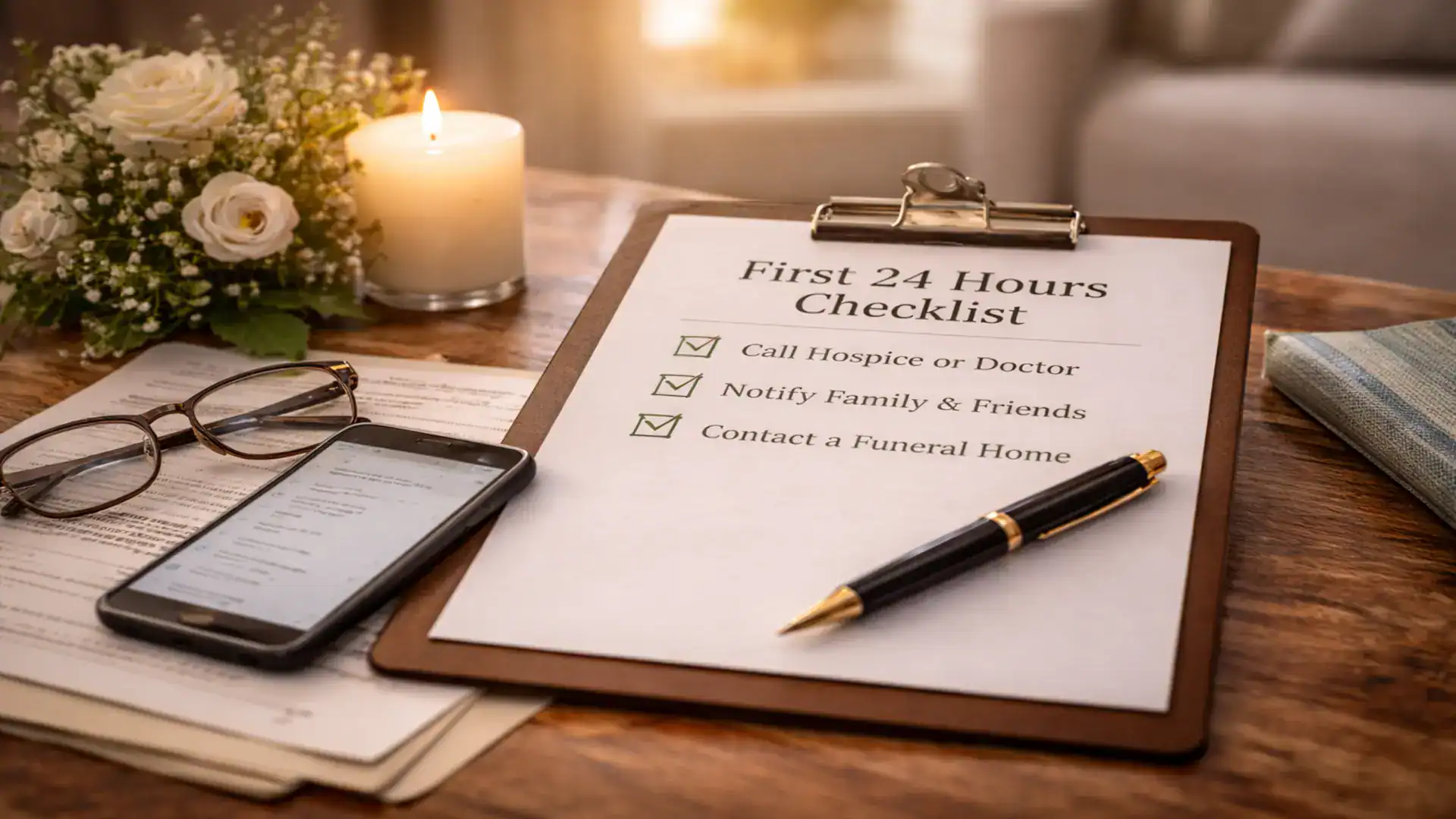
The body cannot remain at home indefinitely, so contacting a funeral home is one of the first logistical steps — typically within the first few hours, even if you haven’t made final arrangements decisions yet.
What to expect when you call:
- They will ask for the location of the deceased
- They will arrange transportation of the body
- They will begin gathering basic information (full legal name, date of birth, Social Security number)
- You do not need to make all decisions right now — a reputable provider will give you time
Questions to ask:
- What are your transportation fees and service area?
- When will you need us to make decisions about services?
- Can you help us obtain death certificates?
- What identification documents will you need from us?
If your loved one had pre-arranged their funeral or cremation, locate that documentation now — it will guide all of the decisions that follow.
Step 4: Secure the Home and Immediate Environment
If the person lived alone:
- Secure the home — lock doors and windows
- Find any pets and arrange care
- Do not dispose of medications yet — ask the funeral home or hospice team about proper medication disposal
- Locate important documents (will, insurance policies, financial accounts) and put them in a safe place — don’t make decisions about belongings yet
If the person lived with others:
- Identify if any dependents (children, other adults) need immediate care arrangements
- If there are medications that could pose a safety risk to children or others, secure or dispose of them safely
Step 5: Locate Important Documents
In the first 24 hours, try to locate the following if possible. You don’t need to read through everything now — just find and secure them:
- Will and any trust documents
- Life insurance policies (check for beneficiary information)
- Social Security card
- Birth certificate
- Marriage certificate (if applicable)
- Military discharge papers (DD-214) if the deceased was a veteran — this is important for VA benefits
- Pre-arranged funeral or cremation contract if one exists
- Recent financial account statements
If you can’t locate these today, don’t panic. Most can be obtained later, though some — like the DD-214 — can take time to retrieve if the original is lost.
Step 6: Hold Off on Major Decisions
The first 24 hours is not the time to make major financial, legal, or property decisions. Well-meaning family members may push for quick choices — about belongings, finances, the house, or memorial arrangements. Gently hold those conversations off.
Decisions that can wait:
- What to do with the home or belongings
- Reading and executing the will
- Canceling accounts and subscriptions
- Making public announcements (a brief social media post is fine; a full obituary can wait)
The one exception: If a formal funeral or memorial service is being planned, some decisions (venue, date, whether to have a viewing) will need to happen within 24–72 hours to secure scheduling.
Step 7: Take Care of Yourself and Those Around You
Grief affects the body as much as the mind. In the first 24 hours, basic physical care for everyone present matters:
- Drink water. Grief triggers adrenaline, which is dehydrating.
- Eat something, even if it’s small. Others may need reminders to eat, too.
- Sleep if you can. Major decisions made while exhausted and grief-stricken are often regretted.
- Accept help. If someone offers to bring food, sit with you, or make a call — let them.
- Don’t drink alcohol excessively. It’s understandable to want to numb pain, but it impairs the judgment you’ll need in the coming days.
If children are present, be honest with them in age-appropriate ways. Children who are shielded from death often feel more confused and frightened than those given simple, truthful explanations.
What Comes Next: Days 2–7
Once the first 24 hours have passed, the next wave of tasks begins. Here’s a brief overview of what the coming week typically involves:
- Obtaining death certificates (you’ll likely need 8–12 certified copies)
- Planning the memorial service with the funeral home
- Notifying government agencies (Social Security Administration, pension providers, VA if applicable)
- Beginning the probate process if the deceased had a will — consult an estate attorney
- Notifying employers, financial institutions, and insurance companies
- Writing and publishing the obituary
- Coordinating out-of-town family travel if a service is being held
Each of these deserves its own careful attention — but they can wait until you’ve had even a brief moment to breathe.
A Note on Grief
There is no right way to grieve. Some people cry immediately. Others go into logistics mode and don’t feel the full weight of loss for weeks. Some oscillate between both within the same hour. All of it is normal.
If you find yourself paralyzed, ask for help — from family, from a grief counselor, or from the funeral home, who guides families through this process every single day. You don’t have to navigate this alone.
We’re Here to Help
At DFS Memorials, we understand that the hours after a loss are among the hardest anyone faces. Our team is available to answer questions, guide you through options, and take some of the logistical weight off your shoulders — so you can be present for the people who need you most.
Nicholas Ille is the co-founder, author, and network director of DFS Memorials. Since launching the network in 2012 with Sara Marsden-Ille, Nicholas has built and managed the 80+ funeral home and cremation provider partnerships that make up the DFS Memorials referral network across the United States and Canada. He oversees provider vetting, network standards, and ongoing relationships with local funeral professionals. He established US Funerals Online & Canadian Funerals in 2003 and continues to research and publish industry information across all 3 websites.